

Patios and Paving
Porcelain and natural stone terraces, laid on a base built to carry them, with the falls and drainage worked out before the first slab goes down.
Why Terraces Are Usually Too Small
The most common fault in a British back garden is not the paving material. It is the size. A terrace gets sized to the slab module or to whatever the previous owner inherited, and then a table goes on it and the chairs hang off the back edge onto the grass. Pull a chair out to sit down and you are on the lawn. In February that means mud on the kitchen floor.
So we start with the furniture and work outwards. A six seat table needs roughly a metre of clearance behind each chair to be usable, and a lounge set needs more than people think. Add a barbecue or an outdoor kitchen run and the terrace grows again. It is far cheaper to add two square metres at the design stage than to extend a terrace three years later and try to match a discontinued slab.
Material comes second. Large format porcelain has taken over most premium residential work for good reasons: it does not need sealing, it resists staining and algae far better than sandstone, and the colour is consistent between packs. Natural stone still wins where the house is older and a slightly softer, more variable surface suits it. We will show you both and tell you which we would use on your elevation.
What We Lay

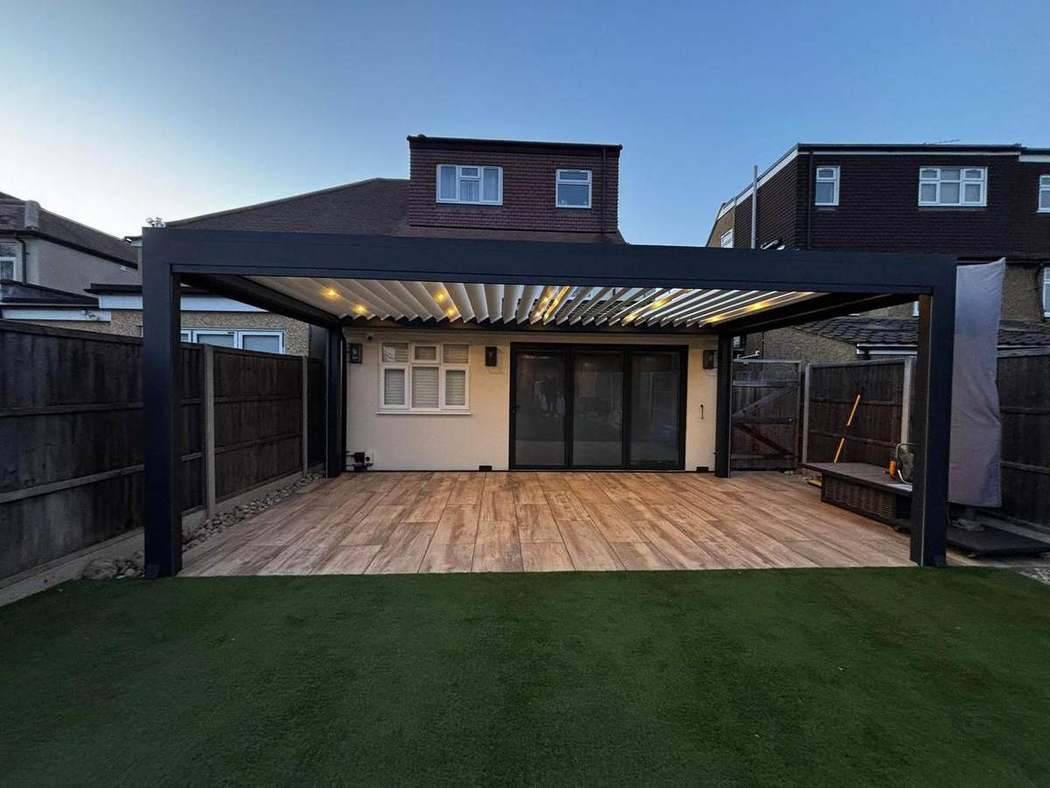
Large Format Porcelain
The default for contemporary terraces: dimensionally consistent, low maintenance and unaffected by frost.
Natural Stone
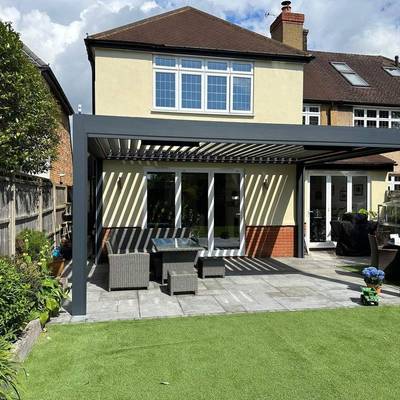
Sandstone, limestone and granite where a period property calls for a softer, more variable surface.

Steps and Level Changes
Wide, generous treads with consistent risers, in the same material or a contrasting one to signal the change.

Edging and Restraint
Steel, brick or concrete restraint so the perimeter stays tight and joints do not open at the lawn edge.
Drainage and Channels
Linear channel drains at thresholds, permeable joints and outfalls sized for the area they serve.

Jointing and Sealing
Correct jointing compound for the material and the joint width, which is where a lot of otherwise good terraces fail.
How a Terrace Gets Laid
Survey and Set Out
Levels taken from the damp proof course, the door thresholds and the existing garden, then the terrace set out against the furniture layout.
Excavation
Reduced dig to the depth the build up needs, with spoil contained and removed rather than spread around the garden.
Sub Base
Granular sub base laid and compacted in layers to the specified depth, which is the part nobody sees and everybody relies on.
Drainage
Channel drains, gullies and outfalls installed and connected before any surface goes down.
Laying
Full mortar bed and primer for porcelain, laid to the set falls, with cuts kept to the perimeter where possible.
Jointing and Clean Down
Jointed, cleaned and left swept, with any protection removed and the site cleared.
Porcelain or Natural Stone
- Maintenance
- Porcelain: wash occasionally, no sealing. Natural stone: periodic sealing on most sandstones, and expect algae on shaded aspects.
- Consistency
- Porcelain: near identical between packs. Natural stone: variation between and within packs, which is part of the appeal and a risk if you dislike surprises.
- Slip resistance
- Both are available with rated finishes. Textured porcelain performs well wet. Smooth honed stone can be slippery in a shaded, damp position.
- Cost
- Porcelain is generally the higher material cost, natural stone the higher long term maintenance cost. Over ten years they are closer than the initial quotations suggest.
- Suits
- Porcelain: contemporary extensions, render, aluminium windows, large format layouts. Stone: period houses, brick, softer planting schemes.
A note on the cheap end of the market: budget porcelain exists and we do not lay it. Poor calibration means the slabs are not the same thickness, which shows up as lipped joints no amount of skill on site can hide.
Patios and Paving Across Surrey and London
Terraces built across Surrey, South West London and the South East, usually as part of a wider garden or structure project.
Epsom, Ewell, Cheam, Banstead, Ashtead, Leatherhead, Cobham, Oxshott, Esher, Weybridge, Walton on Thames, Kingswood, Tadworth, Reigate, Dorking, Guildford, Woking, Virginia Water and Farnham. Also across Richmond, Wimbledon, Putney, Kingston upon Thames, Surbiton, Chiswick, Barnes, Dulwich, Clapham, Wandsworth and the surrounding South West London postcodes.
Patio and Paving FAQs
Is porcelain better than natural stone?
Do you need to remove the old patio?
How much fall does a patio need?
Can a patio be laid right up to the doors?
How long does a patio take to install?
Will you lay paving I have bought myself?
Services That Work Alongside This One
Most projects combine two or three of these. Tell us the whole plan and we will quote it as one job.
Get Your Terrace Sized Properly
Book a free survey. We will bring samples, measure the space against the furniture you actually own, and quote the whole job including the groundwork.