
Garden Drainage and Groundworks

Waterlogged lawns, standing water on terraces and bases for structures. The work that happens before anything visible, and the reason most gardens either last or fail.

Below the Surface

Most Garden Problems Are Water Problems

A large part of Surrey and South West London sits on London Clay. Clay holds water, drains slowly and moves as it wets and dries, which is why so many gardens in this area are unusable from November to March and rock hard by July. It is also why a terrace laid without thought about where water goes will lift, settle or green over within a couple of winters.

Drainage is not one product. A lawn that squelches needs a different answer from a terrace with a puddle in the middle, which needs a different answer again from water sitting against the house. The starting point is always finding out where the water is coming from and where it can legally and practically go, which is a survey question rather than a catalogue question.

Groundworks is the other half of the same job. Foundations for a pergola, bases for an outdoor kitchen or garden room, sub bases under terraces and the levels that tie it all back to the house. We do this work because we install structures onto it, and we would rather control the base than inherit somebody else's.
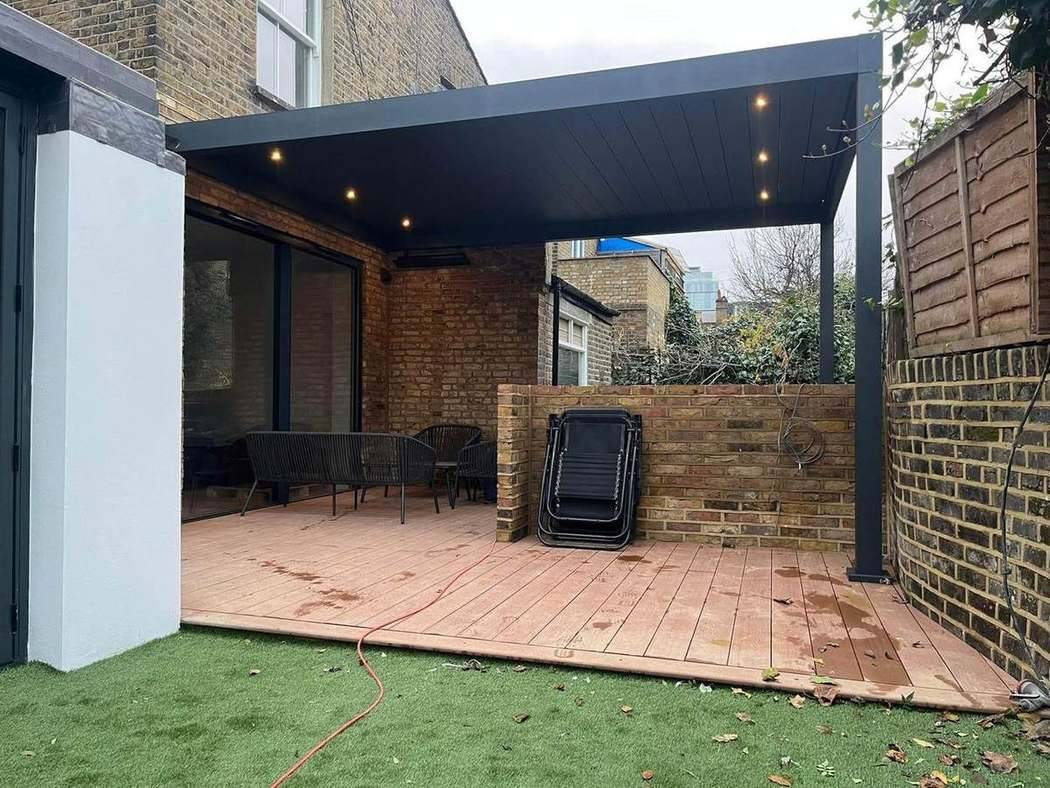
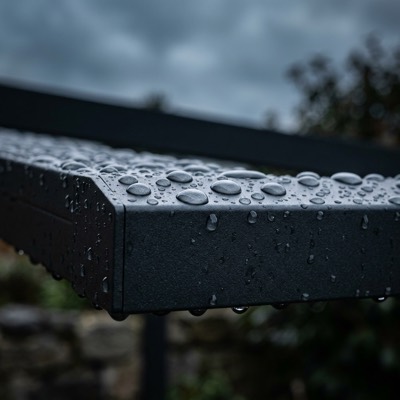
Site prepared and levelled ahead of a Harmony View pergola installation
The Work

What We Install

  • Land drainage systemsPerforated drains in permeable fill, laid to fall and connected to a suitable outfall, for lawns that hold water through winter.
  • Channel and threshold drainsLinear drains along door thresholds and terrace edges, which is what makes a flush transition from inside to outside possible.
  • SoakawaysSized and sited for the area they serve and the ground they sit in, at the correct distance from buildings.
  • Terrace falls and outfallsLevels set so water leaves the surface and the building, rather than pooling in the middle or running back to the wall.
  • Foundations and padsConcrete pads and fixing points for pergolas, outdoor kitchens and garden rooms, set out from the structural drawings.
  • Sub bases and levelsReduced dig, graded fill compacted in layers, and levels tied back to the damp proof course and door thresholds.
Common Problems

What People Call Us About

Standing Water on a Terrace

Usually no fall, the wrong fall, or blocked outfalls. Sometimes fixable with a channel drain, sometimes not.
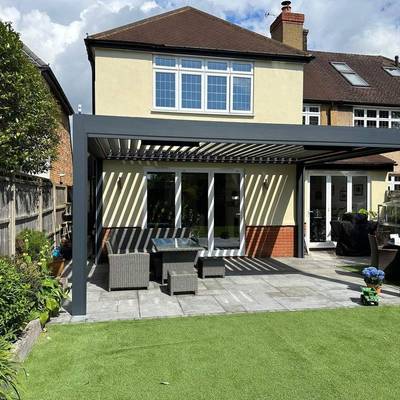
Water Against the House

A terrace built up too high or falling back towards the wall. This one is worth dealing with promptly.

Lawns That Never Dry Out

Clay, compaction, or a garden that receives run off from everywhere else. Different causes, different fixes.

Settlement and Lipped Paving

Almost always an inadequate sub base. Improving drainage helps, but the base is the real fault.

Bases That Will Not Take a Structure

Thin slabs on sand with nothing beneath. We form pads rather than bolt into hope.

Blocked Pergola Drainage

Structure drainage running into a blocked or non existent outfall, which then backs up through the roof.

Realistic Expectations

What Drainage Can and Cannot Do

Can do
Move surface water off terraces and away from the house reliably, and keep a structure's drainage running to a proper outfall.
Can usually do
Turn a lawn that is unusable for four months into one that is usable for most of the year with a few soft weeks.
Cannot do
Guarantee a dry lawn in every February on heavy clay with a high water table. Anybody promising that is guessing.
Depends entirely on the site
Soakaway performance. Clay drains slowly and a soakaway in poor ground is money spent on a hole. We test before specifying.
Needs the neighbours
Where water arrives from adjoining land, a full solution may involve conversations beyond your boundary. We will tell you if that is the situation.

Groundworks is the least glamorous money you will spend on a garden and the most consequential. If the budget is tight we would rather build a smaller terrace on a proper base than a large one on a poor one.

Where We Work

Drainage and Groundworks Across Surrey and London

We work across the clay belt of Surrey and South West London, where drainage is a routine part of almost every garden project rather than an exception.

Epsom, Ewell, Cheam, Banstead, Ashtead, Leatherhead, Cobham, Oxshott, Esher, Weybridge, Walton on Thames, Kingswood, Tadworth, Reigate, Dorking, Guildford, Woking, Virginia Water and Farnham. Also across Richmond, Wimbledon, Putney, Kingston upon Thames, Surbiton, Chiswick, Barnes, Dulwich, Clapham, Wandsworth and the surrounding South West London postcodes.

Questions

Drainage and Groundworks FAQs

My lawn is waterlogged every winter. Can it be fixed?
Usually it can be improved a great deal, though on heavy clay with a high water table nobody can promise a perfectly dry lawn in February. The options range from aeration and sand banding through to a land drain system connected to a soakaway. We would rather set realistic expectations at the survey than take money for a guarantee we cannot keep.
Where is drainage water allowed to go?
Surface water normally goes to a soakaway or an existing surface water drain, subject to ground conditions and the site. Connecting surface water into a foul drain is not permitted. Soakaways need suitable ground and minimum distances from buildings. We assess this on site and we do not connect anything without establishing what the drain is.
Do I need permission for drainage work?
Straightforward garden drainage generally does not need planning permission. Building regulations and water company requirements can apply to connections, larger schemes and anything affecting a public sewer. We flag it where it applies. For anything near a public sewer, confirm with your water authority before work begins.
What base does a pergola need?
It depends on the structure size, the wind loading and what is already there. A sound concrete slab or a properly built patio on a compacted sub base will often take fixings directly. Where it will not, we form localised concrete pads at the post positions, which can usually be done within an existing terrace with minimal disruption.
Can you drain an existing patio without lifting it?
Sometimes. Adding a channel drain along one edge and creating an outfall can solve standing water where the falls are only marginally wrong. Where the terrace falls back towards the house, or has no fall at all, lifting and relaying is the only honest fix.
Do you deal with the spoil?
Yes. Excavation generates far more material than people expect and removing it is a genuine cost, especially with no vehicle access. We include it in the quotation rather than leaving it as a surprise.
Related Services

Services That Work Alongside This One

Most projects combine two or three of these. Tell us the whole plan and we will quote it as one job.

Hard Landscaping

Sub bases, retaining structures and levels built on the groundwork.

Hard landscaping

Patios & Paving

Terraces laid to correct falls with drainage designed in.

Patios and paving

Pergola Installation

Structures fixed to bases we have specified and built ourselves.

Installation
Free Design Consultation

Find Out What Is Actually Under Your Garden

Book a free survey. We will look at levels, falls, ground conditions and existing drainage, and tell you what can realistically be improved.

Call Now Free Quote